
Finding out what the chapter actually needed, before deciding how to fix it
Responses
38
Aware templates existed
71%
Used one recently
18%
Prefer FigJam over Mural
8 to 1
Used a shared template in the last 4 weeks
Respondents by role
The chapter had a long list of tools and templates spread across FigJam, Mural, the playbook, and other internal sources, and the original task was to migrate and realign them with the new visual identity. Before doing that, I ran research to understand what was actually needed. The research changed the direction of the project entirely, and what came out of it eventually inspired a colleague to build something new.
Templates existed across FigJam and Mural, the design playbook, service design materials, and product management resources, and the original assumption was that they simply needed to be migrated and made visually consistent. Nobody had checked whether migration was actually the thing designers needed.
I designed and ran a survey to understand which tools were actually being used, by whom, and why, rather than assuming the answer was migration. 38 responses came back from UX Designers, UX Researchers, and Service Designers across the chapter.
Participants
38 responses
UX Designers, UX Researchers, and Service Designers
Research objective
Understand usage of shared DXD templates
Identify gaps and improvement opportunities
Scope
Shared templates in FigJam and Mural
The core insight: awareness was high, but usage was low. Most people knew the templates existed. Only about 18% had used one recently. Many designers relied on their own templates instead.
Aware templates existed
71%
Used one recently
18%
The shift wasn't about moving from one tool library to another. It was about turning a generic, scattered collection of resources into something guided, contextual, and structured, a direct response to the gap the survey at the top of this case study revealed.
I started by mapping every existing tool across Figma, Mural, the product management page, service design materials, and the digital experience playbook. I then organized that full list against the design process, Understand, Concept, Define, Develop, and Grow, and color coded each tool by which discipline it served, UX Design, UX Research, or Service Design. This turned a scattered pile of resources into a structured view of the actual workflow, and made the real gaps visible for the first time.
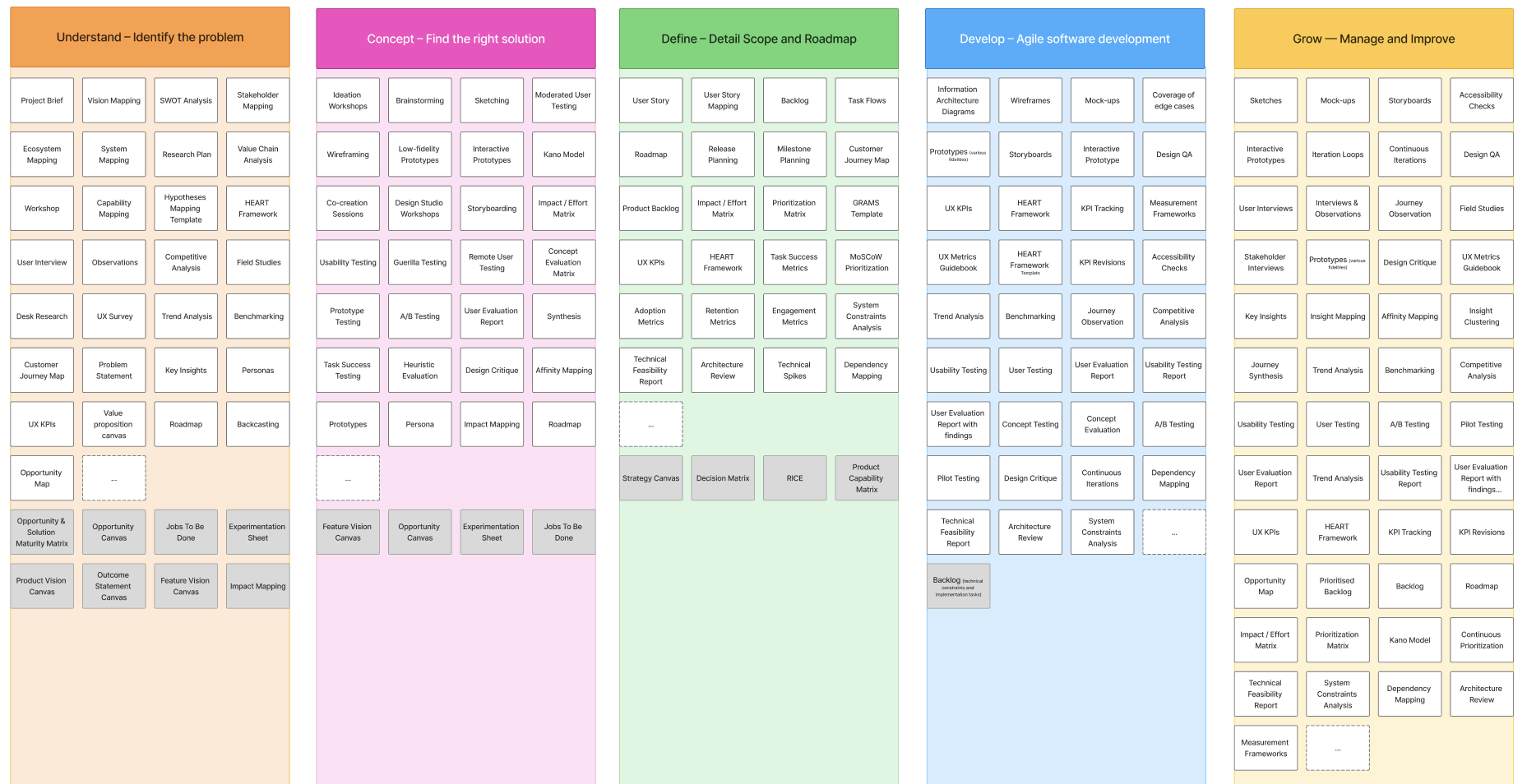
Based on the research, I defined what a genuinely useful template needs: an existing example, a clear description of what the template is, guidance on how it works and when to use it, useful links or references, step-by-step instructions, and a version ready to copy. This became the structure I proposed to the chapter, organized into a starter kit, an advanced kit, and a per-discipline view.
1
An existing example
2
What this template is
3
How it works and when to use it
4
Useful links or references
5
Step-by-step guidance
6
A version ready to copy
To ground the starter kit and advanced kit concept in what each part of the chapter actually needed, I designed and ran a workshop with the managers of UX Design, UX Research, and Service Design.
The workshop inspired a colleague from the UX Design team to build something further: an AI-supported prototype connecting tools directly to each stage of the design process. I didn't build this myself, but they've said directly that the workshop was the spark for it.
The most useful thing this project taught me was to question the task before executing it. I was asked to migrate templates, and the easy path would have been to just do that. Running the research first showed that migration wasn't the actual problem, and that finding changed the direction of the whole project. It's a good reminder that the brief you're given isn't always the problem that needs solving.